
Do you bring Kleenex to performance reviews?
With many clients getting ready for their performance review cycle, I have been casually asking many of my colleagues to tell me their goal of a process that seems to be universally hated.
Some responses I received were, “I’m not sure,” “No idea,” and my favorite, “It’s really just a way to start getting the bad folks out of here.”
Why it matters: Companies are spending countless hours on a task with no simple or consistent answer to one basic question: WHY do we do performance reviews?
These statistics on performance reviews are alarming: Adobe surveyed 1,500 U.S. office workers and found:
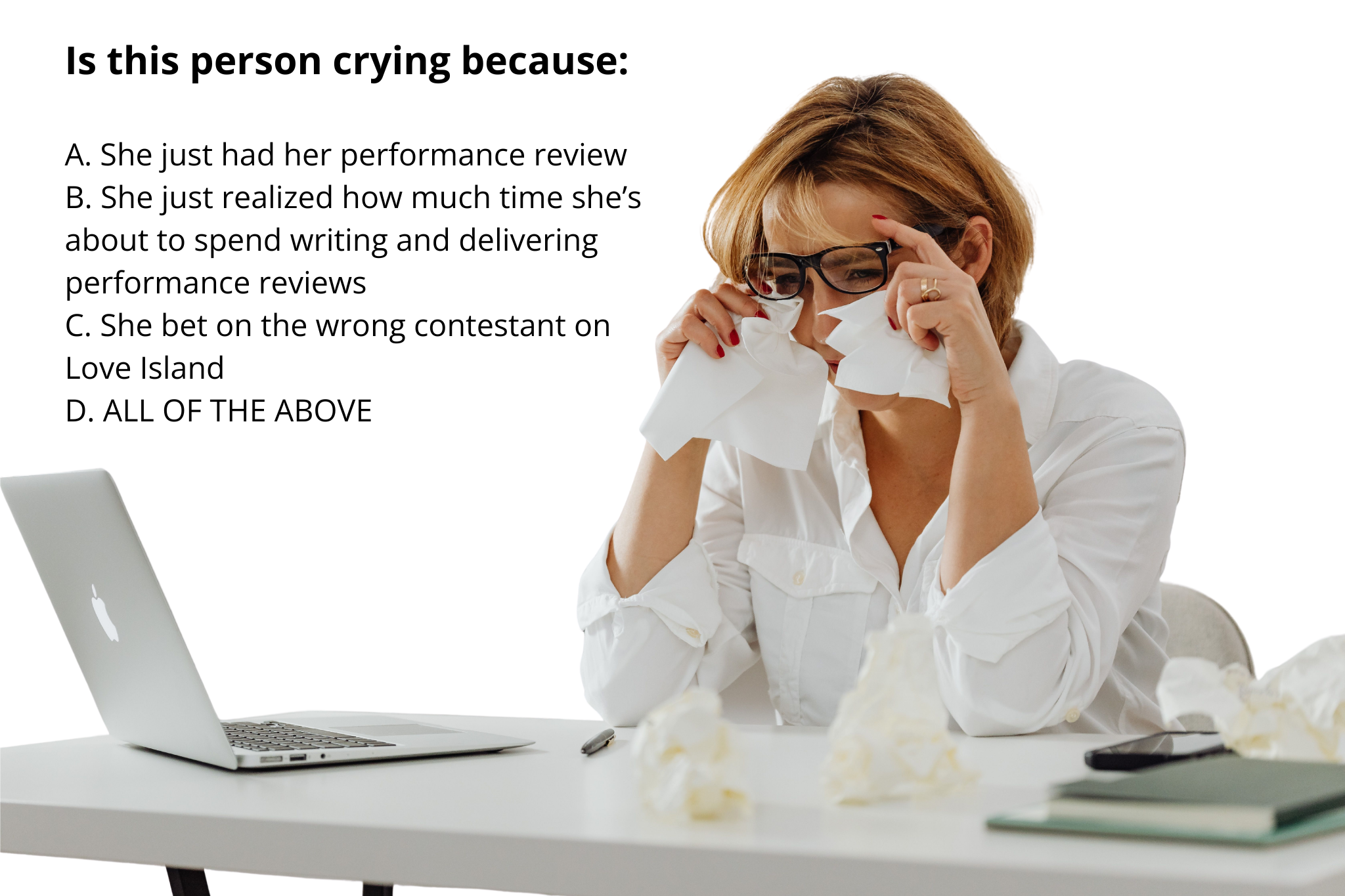
22% of employees said they had cried at least once after receiving a performance review.
20% felt compelled to quit after a bad review.
59% of employees and 60% of managers said reviews had no impact on how they did their jobs.
Think about that: 6% of adults say the last place they cried was at work or school.
The process designed to improve performance appears to make people cry far more often than everyday work itself.
The Japanese manufacturing philosophy known as the 5 Whys, popularized by Toyota, is deceptively simple. When a problem emerges, keep asking "Why?" until you uncover the root cause rather than the symptom.
While the 5 Whys is a well-known approach, it seems to have gone the way of flip phones and paper maps.
I did the 5 Whys with a colleague who oversees the performance cycle at his company of 5,000 employees; it went something like this:
Why do you do performance reviews?
So we can identify the top, middle, and high performers.
Why?
So we can determine the level of merit increase.
Why?
So we give the most merit to high performers.
Why?
So they will stay.
Why?
Because we have trouble keeping great people.
I then reversed the process and started with this question: “What are the most important things your company could do to keep great people?”
“Conduct performance reviews” didn’t make the list.
Netflix has long rejected traditional annual reviews in favor of continuous, candid feedback.
Co-founder Reed Hastings notes "We've been against performance reviews from the beginning. The first problem is that the feedback goes only one way: downward. The second difficulty is that with a traditional performance review you get feedback from only one person, your boss."
We work with clients on ensuring everyone in their company has the tools and resources they need to promote a culture of continuous feedback, coaching, and personal and professional growth.
It’s not enough to say, “Let’s have a culture of feedback and coaching.” People need to know how to do what can often be a delicate task.
The bottom line: If you were starting your company from scratch today, would anyone invent the annual performance review?
If the answer is yes, I might just cry before I ask you five questions. Why? Why? Why? Why? Why?
